



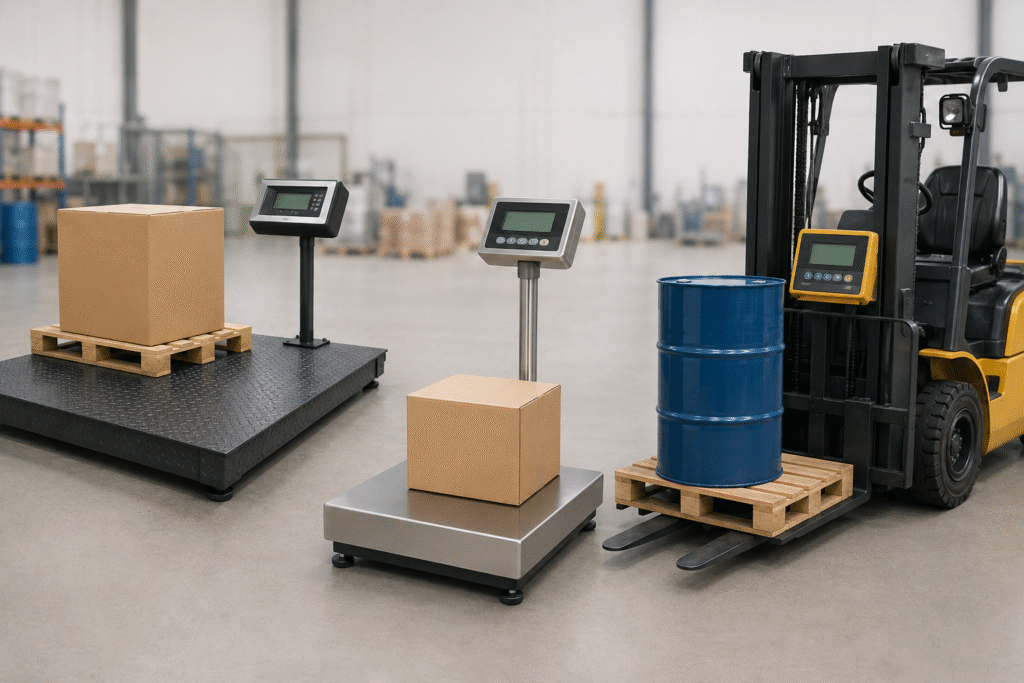
Selecting the right industrial weighing equipment is an important decision for any business that depends on accurate weight measurements. Warehouses, manufacturing plants, logistics companies, recycling facilities and distribution centers all have different operational requirements. Choosing the wrong type of scale can slow down workflows, create unnecessary handling steps, and reduce overall efficiency.
Businesses often turn to an industrial scale supplier early in this process, since identifying the most suitable weighing solution depends on load capacity, application, available space, and daily operational processes. Among the most commonly used industrial weighing systems are floor scales, platform scales and forklift scales. Although they all perform the same basic function, each is built for a distinct purpose.
This guide explains the differences between these three industrial scales and helps you determine which one best fits your operation.
Table of Contents
Understanding Floor Scales
Floor scales are heavy-duty weighing systems installed directly on the floor or within a shallow pit. They’re designed for weighing large, heavy loads that can’t easily be lifted onto smaller weighing equipment.
These scales are commonly used for weighing pallets, containers, drums, crates and bulk materials. Their rugged construction allows them to withstand demanding industrial environments while still delivering reliable, repeatable measurements. When maximum load requirements are unclear, an industrial scale supplier can usually recommend the appropriate floor scale after reviewing the working environment.
Typical applications include:
- Warehousing
- Manufacturing facilities
- Logistics centers
- Food processing plants
- Chemical industries
Most floor scales are compatible with pallet trucks or forklifts, allowing operators to move loads directly onto the weighing platform. They come in various capacities depending on operational needs and can be paired with digital weight indicators or integrated into production systems.
What Are Platform Scales?
Platform scales are versatile weighing systems designed for products, packages, containers, and materials of various sizes. While floor scales are generally built for heavier palletized loads, platform scales are available in a wider range of capacities and platform dimensions, making them suitable for many different applications.
They’re frequently used in:
- Shipping departments
- Packaging operations
- Inventory management
- Quality control
- Production lines
Platform scales work well when products need to be manually loaded or transported onto the weighing surface using carts or pallet trucks. Because these scales come in so many configurations, it often helps to consult an industrial scale supplier who understands the specific weighing needs of different industries before settling on a model. Many platform scale models also have stainless steel construction for environments where hygiene or resistance of corrosion matters.
Understanding Forklift Scales
Forklift scales differ significantly from floor and platform scales because they’re integrated directly into the forklift itself. Instead of transporting materials to a fixed weighing station, operators can weigh loads while lifting and moving them, which eliminates a separate weighing step and cuts down on unnecessary travel within warehouses or production facilities.
Forklift scales are commonly used in:
- Logistics operations
- Distribution centers
- Freight handling
- Manufacturing plants
- Shipping warehouses
Since weighing happens during normal material handling, forklift scales can meaningfully improve workflow efficiency by reducing handling time. Whether forklift-integrated weighing makes sense for a given operation is exactly the kind of question a supplier helps answer, usually by looking at existing equipment and daily workflow before making a recommendation.
Comparing the Three Scale Types
All three scales deliver accurate measurements, but their intended applications differ:
- Floor scales are best suited for heavy palletized loads transported to a dedicated weighing location.
- Platform scales offer greater flexibility for weighing a wide variety of products — ideal for shipping, packaging, and production environments.
- Forklift scales combine material handling and weighing into a single operation, cutting handling time in high-volume facilities.
The right choice depends on:
- Type of materials being weighed
- Frequency of weighing
- Load capacity requirements
- Available floor space
- Existing material handling processes
- Workflow efficiency goals
Rather than choosing equipment based on capacity alone, businesses should think about how the scale fits into their daily operations.
Which Scale Fits Your Business?
If your facility regularly weighs large pallets at a fixed location, floor scales are often the practical choice. If your operation handles products of varying sizes for packaging, shipping, or inventory control, platform scales offer excellent flexibility. And if speed is critical with loads constantly on the move via forklift, forklift scales can reduce unnecessary handling by allowing weighing during normal transport.
Many industrial facilities actually use more than one type of weighing system — a warehouse, for instance, might use forklift scales for incoming goods while keeping platform scales for quality checks and floor scales for heavier pallet loads. This is often where an industrial scale supplier adds the most value, evaluating operational requirements across the whole facility rather than offering a one-size-fits-all solution.
Choosing the Right Industrial Weighing Partner
Industrial weighing equipment is a long-term investment. Beyond selecting the correct scale, businesses should also think about installation, calibration, maintenance, and technical support.
As an established industrial scale supplier, HIRS Global supplies a wide range of industrial weighing solutions, including floor scales, platform scales, forklift scales, weighbridges, pallet jack scales, crane scales, and other specialized weighing systems. Their solutions support industries such as logistics, manufacturing, retail, warehousing, construction, and material handling across the UAE, Saudi Arabia, and Oman.
Working with a trusted supplier makes sure that your businesses receive equipment matched to their operational requirements , along with professional installation, calibration services, maintenance support and genuine spare parts when needed.
Conclusion
There’s no universal industrial scale that suits every business. Floor scales, platform scales, and forklift scales each serve different operational purposes. Understanding how materials move through your facility is the key to selecting the most efficient weighing solution.
By evaluating your workflow, load capacities, available space, and production processes, you can invest in equipment that improves productivity while maintaining reliable weight measurements. Contact HIRS Global today to make sure you choose the right weighing solution for both your current operations and future business growth.
FAQ
Can I use one scale type for all my weighing needs, or do I need multiple ?
Many facilities use a combination — for example, forklift scales for incoming goods, platform scales for quality checks, and floor scales for heavier pallets. The right mix depends on your materials, workflow, and volume.
What’s the main difference between a floor scale, a platform scale, and a forklift scale ?
Floor scales are fixed, heavy-duty units installed on or near the ground for weighing large palletized loads. Platform scales are more versatile, come in varied sizes and capacities and suit manually loaded products. Forklift scales are built into the forklift itself, letting you weigh loads while lifting and transporting them, skipping a separate weighing step entirely.
What should I look for in a reliable industrial scale supplier ?
Beyond just supplying equipment, a good supplier should also offer installation, calibration, maintenance support, and genuine spare parts to support your equipment long-term.