Selecting the right truck scale is crucial for ensuring accurate weighing, regulatory compliance, and long-term efficiency at logistics hubs, industrial sites, and transportation operations. By investing in the right truck scale, businesses can streamline their operations, improve safety, and meet all regulatory standards. This guide outlines the essential considerations for choosing the optimal truck scale and highlights key factors such as truck scale types, site planning essentials, foundation options, and software systems.
Key Truck Scale Types
Truck scales come in different configurations, each designed to meet specific operational needs like traffic volume, vehicle size, and weighing precision. Selecting the correct scale type is critical to ensuring smooth operations. The most common types of truck scales include:
- Full-Length Scales
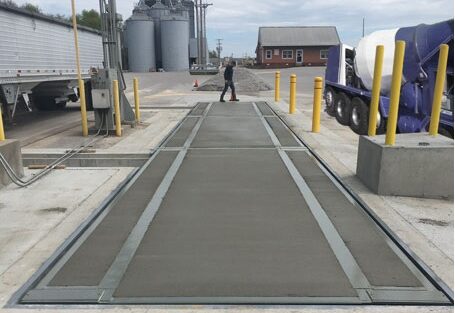
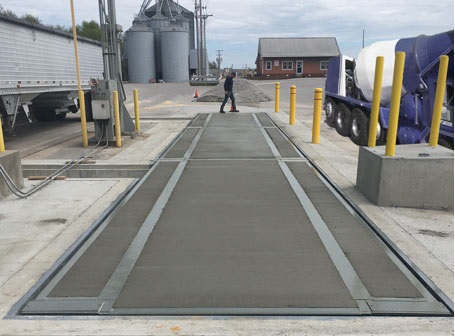
Full-length truck scales accommodate entire trucks in one stop, making them ideal for legal-for-trade transactions. These scales are typically used in industries that require precise weight measurements for trade purposes and are designed to handle heavy loads—up to 280,000 lbs (140 tons) in some models. Full-length scales are perfect for heavy-duty operations where high accuracy is paramount. - Multi-Axle Scales
Multi-axle truck scales capture individual axle weights alongside the gross weight of the vehicle. This is particularly useful for compliance checks where regulations specify axle limits. These scales are suitable for operations that must monitor axle weight distribution to avoid fines for overloading. - Weigh-in-Motion Systems
Weigh-in-motion (WIM) systems allow vehicles to be weighed as they move across the scale without needing to stop. These systems are designed for high-volume environments where throughput is essential, such as toll booths, highway weigh stations, and busy ports. WIM systems enhance efficiency and are perfect for industries that require continuous flow and fast decision-making.
Truck Scale Selection Guide: Processing Speed and Capacity
| Scale Type | Processing Speed | Typical Capacity | Best For |
| Single-Axle | Slow (multiple stops) | Up to 130 tons | Compliance checks |
| Full-Length | Medium (one stop) | 60-120 ft long | Trade transactions |
| Multi-Axle | Medium-High | Varies by number of axles | Axle monitoring |
| Weigh-in-Motion | Fastest (no stop) | Varies by speed | Heavy traffic |
Site Planning Essentials
Planning the installation of a truck scale involves much more than just selecting the right scale type. Thoughtful site planning is crucial for ensuring long-term operational success and minimizing maintenance costs.
- Assess Traffic Volume
The number of trucks expected to use the scale daily plays a pivotal role in determining the scale’s type, number, and positioning. For smaller sites (50-100 trucks per day), one scale may be sufficient, paired with bypass lanes to speed up operations. However, high-volume operations (>200 trucks per day) require multiple scales and carefully planned traffic controls to avoid bottlenecks. - Evaluate Soil and Drainage Conditions
Conducting soil tests (typically through test borings) is essential to understand the soil’s bearing capacity, which directly impacts the choice of foundation. Soil bearing should range from 1,500-2,500 psf for optimal performance. It’s also crucial to ensure proper drainage to prevent water from accumulating around the scale, which could cause instability. - Approach and Site Layout
Ensure the approaches to the truck scale are wide enough for efficient truck entry and exit, typically twice the width of the weighbridge. Approaches should have minimal slopes (ideally ½ inch per foot) to avoid measurement inaccuracies due to angle variations.
Foundation Options for Truck Scales
A stable foundation is essential for ensuring that your truck scale remains accurate over time. There are several foundation types to choose from based on soil conditions:
- Pier Foundations
Pier foundations are best suited for strong soils (2,500 psf minimum). Concrete piers are placed below the frost line, ensuring stability even in freezing temperatures. - Beam-Slab Foundations
Beam-slab designs are ideal for weaker soils (1,500 psf minimum). They offer extra support by using beams that form a ladder-like grid beneath the slab, which distributes the weight evenly. - Pit Foundations
Pit foundations provide a flush-to-ground setup, offering ease of access for vehicles. However, they require sump pumps for drainage, making them a more complex and maintenance-intensive solution.
Truck Scale Software and Accessories
Selecting the right software and accessories for your truck scale can significantly improve operational efficiency and data management. Basic software typically handles single-site transactions, providing features like customer presets and simple reporting. However, for larger, more complex operations, advanced software solutions are available that support multi-site networking, real-time data tracking, and web-based reporting.
In addition to software, accessories such as unattended terminals allow for 24/7 self-service for truck drivers, reducing the need for on-site operators. Incorporating remote displays, gates, and traffic lights can help improve traffic flow and minimize congestion around the truck scale.
HIRS Global: Your Trusted Truck Scale Supplier
When selecting a truck scale for your operation, partnering with a reputable truck scale supplier is key. HIRS Global is a leading provider of high-quality truck scales tailored to the specific needs of the UAE and Saudi Arabia logistics sector. With decades of experience, HIRS Global offers advanced solutions that integrate IoT technology for real-time monitoring, ensuring accurate weight measurement and seamless data management.
As a trusted truck scale supplier, HIRS Global specializes in providing durable foundations and automated systems that align with Dubai’s stringent transport regulations. Their solutions are designed to enhance operational efficiency, minimize downtime, and ensure compliance with all relevant industry standards. Whether you’re running a small logistics hub or a large-scale industrial operation, HIRS Global can provide the custom setups you need to succeed.
Consult HIRS Global Early for Customized Solutions
To avoid costly errors in installation and ensure your truck scale is perfectly suited to your needs, it’s highly recommended to consult HIRS Global early in the planning phase. Their experts can conduct site surveys to assess your location’s specific requirements and provide tailored solutions that will optimize your operations from day one.
Website: https://hirsglobal.com/
Email: sales@hirsglobal.com
Dubai-UAE: +971506971524
Saudi Arabia: +966501718248 / +966562562235
What are the main types of truck scales?
The most common types of truck scales are full-length scales, multi-axle scales, and weigh-in-motion systems. Each scale is designed to handle specific needs, such as compliance checks, axle monitoring, and high-volume operations.
Why is site planning important when choosing a truck scale?
Site planning is crucial for ensuring the truck scale performs efficiently. Factors like traffic volume, soil conditions, and appropriate foundations directly impact the scale’s accuracy, durability, and operational success.
.
How can HIRS Global assist with selecting and installing a truck scale?
As a leading truck scale supplier, HIRS Global offers tailored solutions for UAE and Saudi Arabia’s logistics sector. Their experts provide site